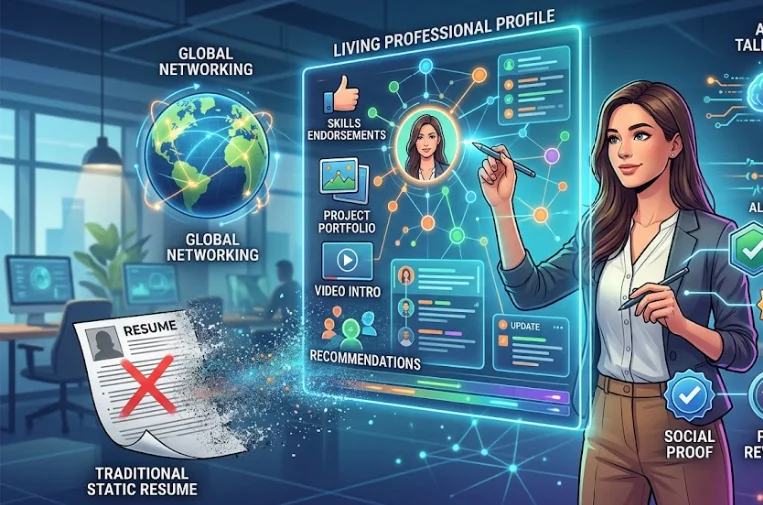
The future of hiring is moving away from static documents and toward dynamic, connected professional ecosystems. Traditional resumes are no longer the only or even the primary way candidates are evaluated. Instead, networking-integrated resume platforms are emerging as systems that combine professional identity, skills, achievements, and social connections into a single living profile. These platforms are designed to reflect how careers actually function today: continuously evolving, socially validated, and increasingly digital-first.
Why Traditional Resumes Are Becoming Limited
Traditional resumes were built for a paper-based hiring era. They are static, manually updated, and often disconnected from real-time professional activity.
Key limitations include:
- No real-time updates or activity tracking
- Limited social or peer validation
- Difficulty showcasing ongoing projects or learning
- Lack of context beyond job descriptions
Modern hiring requires more dynamic and verifiable information.
What Networking-Integrated Resume Platforms Are
Networking-integrated resume platforms combine traditional resume elements with social networking and professional engagement features.
They function as:
- A professional identity profile
- A skills and project showcase
- A networking and visibility system
- A real-time career activity feed
Instead of a static document, the resume becomes a living digital presence.
The Shift From Static Resumes to Living Profiles
One of the most important changes in hiring technology is the shift toward living profiles that update continuously.
This shift includes:
- Real-time skill updates based on activity
- Automatic project and achievement logging
- Continuous peer endorsements and validation
This creates a more accurate reflection of current capability.
Core Features of Future Resume Networking Platforms
Future platforms will likely combine multiple layers of professional identity.
Key features include:
- Integrated resume and portfolio view
- Skill graphs updated through verified activity
- Project timelines with measurable outcomes
- Direct networking with hiring managers and peers
These features reduce reliance on manually curated resumes.
The Rise of Embedded Social Proof
Social proof is becoming a central part of professional evaluation.
In networking-integrated systems, this may include:
- Peer endorsements tied to specific skills
- Verified project contributions
- Public recommendations linked to outcomes
Unlike traditional references, this social proof is continuously visible and updated.
How AI Will Power Profile Matching and Visibility
Artificial intelligence will play a major role in connecting candidates with opportunities.
AI systems will likely:
- Match candidates to roles based on skill signals, not just keywords
- Analyze real-time activity and project contributions
- Rank visibility based on relevance and engagement
This reduces manual filtering and increases precision in hiring decisions.
How Recruitment Will Change
Recruiters will move from resume screening to profile exploration.
This shift includes:
- Searching talent through network ecosystems
- Evaluating continuous activity instead of static history
- Engaging candidates directly through platforms
Hiring becomes more interactive and less document-based.
Benefits for Candidates and Employers
Networking-integrated resume platforms offer advantages for both sides of the hiring process.
For candidates:
- More visibility based on skills and activity
- Reduced dependency on formal job titles
- Stronger proof of real-world capabilities
For employers:
- Better talent discovery through real-time data
- Improved verification of skills and experience
- Faster and more accurate hiring decisions
Challenges and Risks of Network-Driven Hiring
Despite its advantages, this model also introduces challenges.
Potential risks include:
- Over-reliance on visibility rather than capability
- Bias toward highly active or well-networked individuals
- Privacy concerns related to continuous data sharing
Balancing transparency and fairness will be critical.
What the User Experience May Look Like
Future platforms may feel more like professional ecosystems than resume tools.
Possible user experience elements include:
- Interactive skill dashboards updated automatically
- Live project feeds linked to portfolio items
- Direct messaging between candidates and recruiters
- AI-generated career insights and recommendations
The experience becomes continuous rather than application-based.
Conclusion
Networking-integrated resume platforms represent a major evolution in how professional identity is built, shared, and evaluated. They move beyond static resumes toward dynamic systems that reflect real-time skills, verified contributions, and professional relationships.
While traditional resumes will still exist, their role will likely shift toward summary documents, while networking platforms become the primary source of career intelligence.
The future of hiring is not just about what you have done in the past, but how your professional presence continues to grow, interact, and prove value in real time.