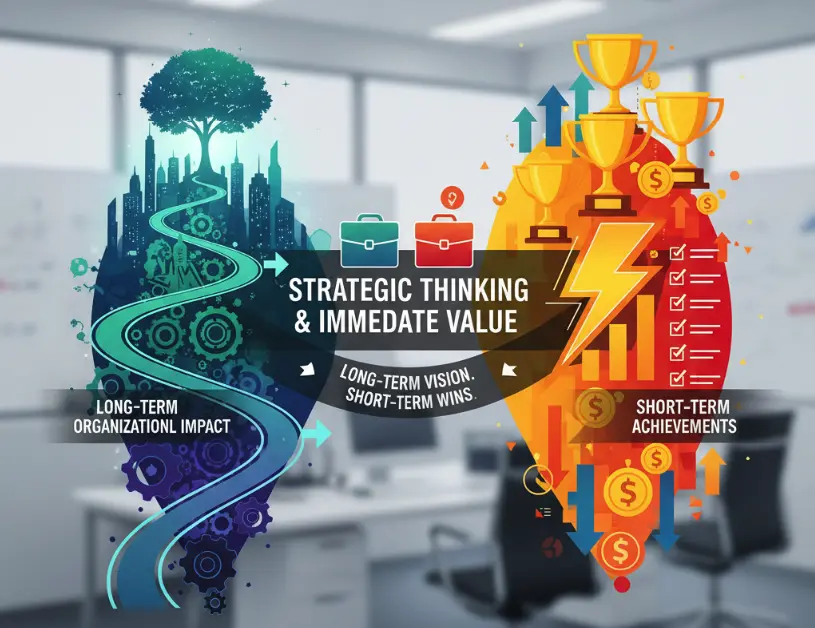
Professionals often struggle with a common challenge when writing resumes, portfolios, or professional summaries. They must decide whether to emphasize quick measurable achievements or demonstrate long-term strategic influence. Both forms of impact are valuable, but they communicate different types of professional strength. Short-term wins show speed, execution, and the ability to deliver fast results. Long-term impact reflects strategic thinking, leadership, sustainability, and the ability to create lasting value. Recruiters, hiring managers, and executives evaluate both dimensions when assessing candidates. Understanding how to clearly present both types of achievements allows professionals to demonstrate not only what they accomplished quickly but also how their contributions continued to benefit organizations long after the initial result.
The Difference Between Short-Term Wins and Long-Term Impact
What Are Short-Term Wins
Short-term wins are achievements that generate immediate results within a relatively brief period. These outcomes usually occur within weeks or months after implementation and are often tied to specific projects, campaigns, or operational improvements. Examples include increasing website traffic after launching a marketing campaign, reducing customer response time by implementing a support tool, or boosting sales during a promotional event.
These achievements are valuable because they demonstrate execution ability. Employers appreciate professionals who can quickly identify problems, implement solutions, and produce measurable results. Short-term wins also show adaptability, responsiveness, and productivity. However, by themselves they may not always demonstrate long-term strategic thinking.
What Is Long-Term Impact
Long-term impact reflects sustained value created over extended periods such as years rather than months. It involves building systems, strategies, products, or processes that continue generating benefits well beyond the initial implementation. Long-term impact might include designing a scalable business process, establishing a companywide automation framework, launching a product that continues to generate revenue years later, or implementing a customer retention strategy that consistently improves lifetime value.
This type of achievement demonstrates strategic thinking, leadership influence, and the ability to create durable organizational improvements. While short-term wins show speed, long-term impact shows depth and foresight.
Why Balancing Both Types of Achievements Matters
Organizations rarely look for only one type of impact. Companies need professionals who can solve immediate problems while also contributing to sustainable growth. A candidate who only highlights quick results may appear tactical rather than strategic. Conversely, a candidate who only emphasizes long-term initiatives may appear slow to execute or disconnected from immediate business needs.
Balancing both types of achievements demonstrates a powerful combination of skills. It shows that a professional can act quickly when necessary while also thinking beyond immediate outcomes. This combination signals maturity, leadership capability, and business awareness.
How to Effectively Show Short-Term Wins
Use Immediate Metrics and Performance Indicators
Short-term achievements are best communicated through specific metrics and quantifiable outcomes. Numbers create clarity and credibility. When presenting short-term wins, focus on performance indicators that changed shortly after your actions. Examples include increased conversions, reduced operational costs, improved customer satisfaction scores, or shortened project delivery times.
Clear metrics allow hiring managers to quickly understand the scale and effectiveness of your work. The key is to present outcomes that occurred directly after your intervention or initiative.
Highlight Fast Results and Rapid Improvements
Short-term success stories should emphasize the speed of improvement. If a campaign produced results within a few weeks or a workflow optimization improved productivity in a single quarter, highlighting that timeline strengthens the achievement. Rapid results show problem solving ability and operational efficiency.
How to Demonstrate Long-Term Impact
Show Sustained Growth Over Time
One of the most effective ways to demonstrate long-term impact is by highlighting growth that continued over an extended period. For example, if a marketing framework increased customer acquisition for multiple years or a product feature drove recurring revenue growth, emphasizing the duration strengthens the achievement.
Sustained performance shows that the initial success was not temporary but part of a durable strategy.
Emphasize Systems and Processes You Built
Long-term value often comes from building repeatable systems rather than delivering one-time results. Examples include establishing automation systems, building scalable infrastructure, designing onboarding frameworks, or creating analytics pipelines that guide decision making.
When professionals create systems rather than isolated solutions, they demonstrate strategic thinking and operational design capabilities.
Demonstrate Scalability and Organizational Influence
Another sign of long-term impact is scalability. If your work expanded across teams, departments, or markets, it indicates broader organizational influence. For example, implementing a workflow that was adopted across multiple departments shows leadership and cross-functional value.
How to Combine Short-Term Wins with Long-Term Impact
The strongest professional narratives connect immediate achievements with lasting outcomes. A powerful approach is to present a short-term result followed by the sustained benefit it created. For example, launching a campaign that generated an initial traffic increase can also lead to a long-term growth engine if the campaign framework becomes a repeatable strategy.
Combining both dimensions tells a more complete story. It shows that you not only achieved early success but also created structures that continued delivering results long after the initial launch.
Best Resume Strategies for Presenting Both Types of Impact
To effectively present both forms of achievement, professionals should structure resume bullet points carefully. Start with the action taken, include a measurable short-term result, and when possible add the sustained outcome that followed. This layered storytelling approach highlights both execution speed and strategic value.
Another useful strategy is grouping related achievements under projects or initiatives. This allows candidates to explain how an initial improvement evolved into a larger operational transformation.
Professionals should also prioritize clarity and specificity. Recruiters scan resumes quickly, so achievements should clearly communicate both the immediate benefit and the lasting contribution.
Common Mistakes When Presenting Impact
One common mistake is focusing only on task descriptions rather than results. Another is listing short-term improvements without explaining their broader influence. Some candidates also make the opposite mistake by claiming large strategic outcomes without showing measurable evidence.
Effective professional storytelling requires evidence for both types of achievements. Immediate results prove execution ability, while sustained outcomes demonstrate strategic value.
Conclusion
Presenting both long-term impact and short-term wins is essential for communicating professional value. Quick results demonstrate execution speed and problem solving ability, while sustained achievements highlight strategic thinking and leadership influence. Together they create a well-rounded narrative that shows both tactical efficiency and long-term vision. Professionals who effectively communicate both dimensions position themselves as individuals capable of delivering immediate improvements while also building systems and strategies that generate lasting organizational success.