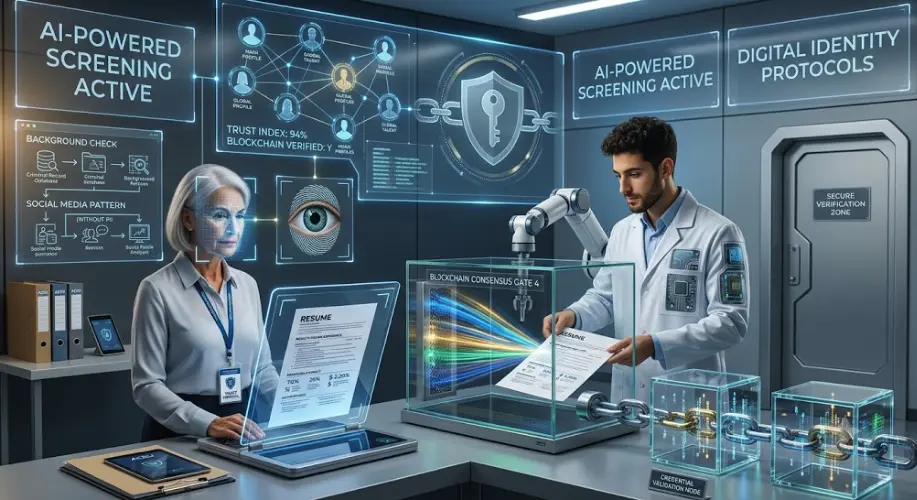
Resume verification is undergoing one of the biggest transformations in modern hiring. What was once a slow, manual process involving emails, reference calls, and document checks is rapidly evolving into a technology-driven ecosystem powered by artificial intelligence, blockchain systems, and digital identity frameworks. As resumes become easier to enhance or even generate using AI tools, employers are under pressure to verify not just what candidates claim, but whether those claims are authentic, consistent, and real. At the same time, hiring is becoming faster, more global, and more remote, which increases the need for automated and scalable verification systems. The future of resume verification is not just about detecting fraud. It is about building trust instantly and continuously across the entire hiring lifecycle.
Why Resume Verification Is Changing
Several major forces are driving the evolution of resume verification systems.
First, hiring has become more digital and global. Candidates apply across borders, industries, and platforms, making manual verification slow and inconsistent.
Second, AI tools now allow candidates to create highly polished resumes that may not always reflect real experience. This increases the risk of misrepresentation and forces employers to adopt stronger verification methods.
Third, companies are under pressure to hire faster while maintaining accuracy. Traditional background checks often slow down hiring pipelines.
These combined pressures are pushing organizations toward automated, intelligent verification systems that operate in real time.
The Problems With Traditional Resume Checks
Traditional verification methods were built for a simpler hiring environment. Today, they struggle to keep up.
Common issues include:
- Slow manual verification processes
- Fragmented data across institutions and employers
- Difficulty verifying international credentials
- High administrative overhead
- Limited ability to detect subtle or AI-assisted fraud
These limitations create delays and increase hiring risk, especially in high-volume or global recruitment.
Recent industry data shows that identity and credential fraud is becoming more common, prompting organizations to expand verification systems beyond traditional checks. :contentReference[oaicite:0]{index=0}
Emerging Technologies Transforming Verification
Modern resume verification is being reshaped by a combination of technologies working together rather than in isolation.
Key technologies include:
- Artificial intelligence and machine learning
- Blockchain-based credential systems
- Decentralized identity frameworks
- API-driven background check platforms
- Natural language processing for skill extraction
These systems aim to reduce manual effort while increasing trust, accuracy, and speed.
Research suggests that combining blockchain with machine learning can improve transparency and reduce credential fraud in hiring systems. :contentReference[oaicite:1]{index=1}
AI-Powered Resume Verification
Artificial intelligence is becoming the backbone of modern resume verification systems. AI models can now analyze resumes, cross-check claims, and identify inconsistencies at scale.
AI systems are capable of:
- Matching resume claims against job descriptions and public data
- Detecting patterns of fabricated or exaggerated experience
- Extracting structured skill profiles from unstructured text
- Flagging inconsistencies across multiple applications
Advanced systems even use multi-agent models to evaluate resumes in context, combining extraction, evaluation, and scoring layers for more accurate screening. :contentReference[oaicite:2]{index=2}
In many cases, AI is already reducing screening time by over 90 percent in experimental hiring systems while improving consistency. :contentReference[oaicite:3]{index=3}
Blockchain-Based Credential Verification
Blockchain technology introduces a major shift in how educational and employment credentials are verified.
Instead of relying on third-party validation or manual checks, blockchain systems store tamper-proof records that can be verified instantly.
These systems allow:
- Instant verification of degrees and certifications
- Immutable employment history records
- Reduced risk of document tampering
- Cross-border credential validation without intermediaries
Blockchain credentials are increasingly seen as a way to create trust in global hiring systems by making verification faster and more reliable. :contentReference[oaicite:4]{index=4}
Real-Time and Continuous Background Verification
A major shift in hiring technology is the move from one-time background checks to continuous verification systems.
Instead of verifying a candidate only at the point of hiring, companies are beginning to monitor credentials and employment status over time.
This includes:
- Continuous employment validation
- Real-time updates to credential records
- Automated alerts for discrepancies
- Integration with HR systems and applicant tracking tools
Industry trends show that employers increasingly view verification as an ongoing process rather than a single step. :contentReference[oaicite:5]{index=5}
Digital Identity and Trust Frameworks
The future of resume verification is closely tied to digital identity systems that unify personal, educational, and professional data.
These systems aim to create a single verified identity layer for candidates, allowing employers to trust data without repeated manual checks.
Modern frameworks include:
- Self-sovereign identity systems
- Verified digital learning and employment records
- Encrypted credential storage with selective disclosure
- Unified skill-based identity profiles
These technologies make it possible to verify both structured credentials and real-world skills securely and privately. :contentReference[oaicite:6]{index=6}
Privacy, Ethics, and Regulation Challenges
As verification systems become more powerful, concerns about privacy and ethics are increasing.
Key challenges include:
- Protecting sensitive personal data
- Preventing algorithmic bias in screening systems
- Ensuring transparency in automated decisions
- Complying with global data protection regulations
Organizations must balance efficiency with fairness and accountability, especially as AI becomes more deeply embedded in hiring workflows.
Regulatory frameworks are also evolving to ensure responsible use of automated verification technologies. :contentReference[oaicite:7]{index=7}
How This Impacts Job Seekers
For candidates, the rise of advanced verification technologies changes how resumes must be written and maintained.
Key impacts include:
- Higher importance of accuracy and honesty in resumes
- Greater reliance on verifiable proof of work
- Integration of portfolios and digital credentials
- Increased visibility of online professional identity
Candidates can no longer rely solely on polished descriptions. They need verifiable evidence to support claims.
What the Hiring Workflow Will Look Like
In the future, resume verification will likely become an integrated, automated part of hiring pipelines.
A typical workflow may include:
- AI parsing of resume content at submission
- Automatic credential verification through blockchain or trusted databases
- Real-time background checks integrated into ATS systems
- Skill-based matching using verified data
- Continuous updates post-hire for compliance and accuracy
This will reduce manual verification delays and shift hiring decisions toward data-backed evaluation systems.
Conclusion
The future of resume verification technologies is moving toward a fully digital, automated, and continuously updated trust ecosystem. AI, blockchain, and identity systems are converging to create faster, more accurate, and more scalable hiring verification processes.
While these technologies significantly improve efficiency and reduce fraud, they also introduce new challenges around privacy, fairness, and transparency. The hiring process is becoming more data-driven, but it must remain human-centered to ensure ethical decision-making.
Ultimately, resume verification is evolving from a manual checkpoint into a real-time trust infrastructure that will define how talent is evaluated in the future of work.