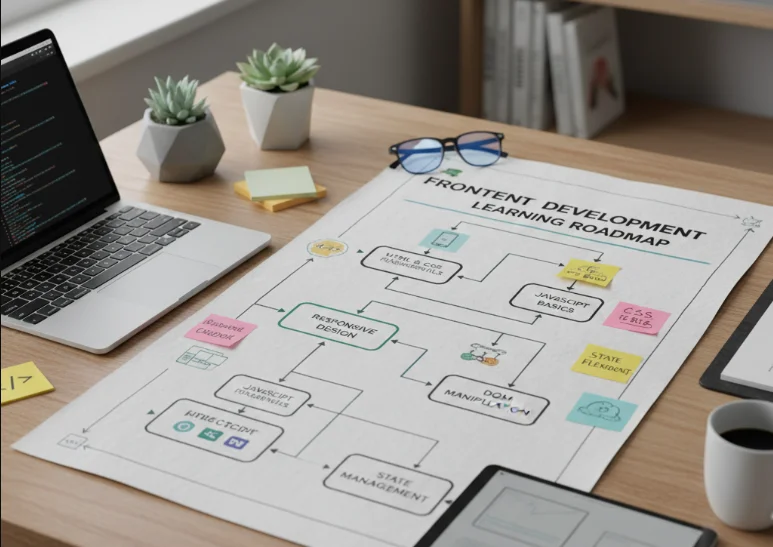
A frontend development learning roadmap is a structured path that helps you progress from beginner-level web concepts to building production-ready applications. Instead of randomly learning tools and tutorials, a roadmap ensures you build skills in a logical order where each concept supports the next.
Why a Frontend Roadmap Matters
Frontend development has many tools, libraries, and frameworks, which can feel overwhelming without direction. A roadmap helps you:
- Learn concepts in the correct sequence
- Avoid skill gaps in fundamentals
- Focus on practical, job-ready skills
- Build real projects instead of isolated knowledge
The goal is not just learning tools, but becoming a capable problem solver in web development.
Phase 1: Web Development Foundations
Before diving into coding heavily, it is important to understand how the web works.
Key concepts include:
- How browsers render web pages
- Client-server architecture
- Basics of the internet (HTTP, HTTPS, DNS)
- How websites are structured
This foundation helps you understand what happens behind every web application.
Phase 2: HTML and CSS Mastery
HTML and CSS form the backbone of frontend development.
HTML focuses on structure:
- Semantic tags like header, section, article
- Forms and input elements
- Page structure and accessibility basics
CSS focuses on design:
- Flexbox and Grid layout systems
- Responsive design principles
- Typography, spacing, and colors
- Animations and transitions
At this stage, you should be able to build static, responsive websites.
Phase 3: JavaScript Fundamentals
JavaScript brings interactivity to websites. It is essential for frontend development.
Core topics include:
- Variables, data types, and operators
- Functions and scope
- Arrays and objects
- DOM manipulation
- Event handling
This phase allows you to turn static pages into interactive applications.
Phase 4: Advanced JavaScript Concepts
Once fundamentals are clear, advanced concepts help you write cleaner and more scalable code.
Important topics include:
- Asynchronous JavaScript (Promises, async/await)
- Closures and higher-order functions
- ES6+ features like destructuring and modules
- Error handling and debugging
These concepts are essential for real-world applications.
Phase 5: Developer Tools and Workflow
Professional frontend development requires familiarity with modern tools.
Key tools include:
- Git and GitHub for version control
- Browser DevTools for debugging
- Package managers like npm
- Code editors like VS Code
These tools improve productivity and collaboration.
Phase 6: Frontend Frameworks
Frameworks help build complex applications efficiently. A popular choice is React.
Key concepts include:
- Component-based architecture
- State and props management
- Routing and navigation
- Reusable UI components
Frameworks allow you to scale applications effectively.
Phase 7: APIs and Asynchronous Development
Modern frontend applications rely heavily on APIs.
You should learn:
- REST APIs and JSON data
- Fetching data using fetch or axios
- Handling loading and error states
- Working with third-party services
This phase connects frontend apps to real-world data.
Phase 8: Real-World Projects
Projects are the most important part of learning frontend development.
You should build:
- Portfolio website
- To-do application
- Weather app using API
- E-commerce UI clone
Projects help convert knowledge into practical skill.
Phase 9: Deployment and Hosting
Once projects are built, they should be deployed online.
Common deployment options include:
- GitHub Pages
- Netlify
- Vercel
Deployment makes your work accessible and professional.
Phase 10: Portfolio and Job Readiness
A portfolio showcases your skills to recruiters and clients.
It should include:
- Clean project presentation
- Live links to applications
- GitHub repositories
- Short descriptions of each project
This phase focuses on presenting your skills professionally.
Final Thoughts
A frontend development learning roadmap is not just a list of technologies, but a structured progression from fundamentals to real-world application. Each phase builds on the previous one, helping you develop both technical skills and problem-solving ability.
Consistency matters more than speed. By following a clear roadmap and building projects along the way, you gradually develop the confidence and capability required for real frontend development roles.