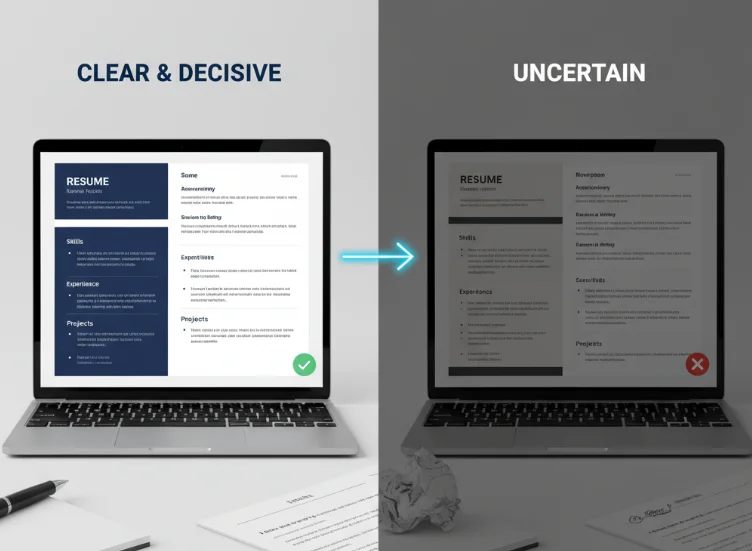
Recruiters form rapid impressions when reviewing resumes, often within only a few seconds of initial scanning. During that short evaluation period, resumes tend to create one of two broad perceptions. Some feel clear, confident, and decisive, while others appear uncertain, passive, or difficult to interpret. These impressions significantly influence whether hiring managers continue reviewing the application or move to another candidate.
A clear and decisive resume communicates professional direction, accountability, and business value with confidence and structure. In contrast, an uncertain resume often contains vague language, inconsistent positioning, unclear achievements, or weak phrasing that makes recruiters question the candidate’s capabilities or focus. The difference is not always based on experience level. Often, it comes down to how information is presented, organized, and communicated. Understanding these recruiter perceptions can help candidates create stronger resumes that inspire trust and professional confidence.
Understanding How Recruiters Perceive Resume Clarity
Recruiters evaluate resumes under significant time pressure. Because they review large numbers of applications, they rely heavily on patterns, phrasing, structure, and readability to form quick judgments about candidates.
A resume feels clear and decisive when it:
- Communicates responsibilities and achievements directly
- Presents a coherent professional narrative
- Shows accountability and ownership
- Highlights meaningful business contributions
- Uses structured and organized formatting
- Maintains consistent professional positioning
An uncertain resume, on the other hand, often creates confusion about what the candidate actually contributed, what role they want, or how their experience connects together.
Recruiters generally associate decisiveness with professionalism, leadership potential, operational discipline, and execution capability.
Why Clear and Decisive Resumes Perform Better
Hiring managers want confidence that candidates can communicate effectively, execute responsibilities independently, and contribute strategically within the organization. A resume that feels decisive often suggests strong communication skills, accountability, and professional maturity.
Decisive resumes tend to perform better because they:
- Reduce recruiter uncertainty
- Communicate value quickly
- Demonstrate confidence without exaggeration
- Show operational clarity
- Create stronger first impressions
- Make achievements easier to understand
Recruiters often interpret unclear resumes as signs of weak communication, low confidence, or lack of meaningful impact, even when the candidate may actually have strong experience.
Resume Signals That Create a Clear and Decisive Impression
Direct and Action-Oriented Language
One of the strongest indicators of resume clarity is direct language. Recruiters respond positively to candidates who describe their work with confidence, precision, and accountability.
Strong action-oriented verbs include:
- Led
- Developed
- Implemented
- Optimized
- Directed
- Managed
- Executed
- Designed
- Improved
- Coordinated
For example:
- Implemented workflow improvements that enhanced operational visibility across teams
- Led cross-functional coordination during system migration initiatives
These examples feel more confident and credible than passive or uncertain wording.
Structured Achievement Presentation
Clear resumes organize accomplishments logically and consistently. Recruiters often prefer bullet points that explain:
- The responsibility or challenge
- The action taken
- The resulting improvement or outcome
This structure helps hiring managers quickly understand how the candidate contributed value.
For example:
- Redesigned reporting workflows to improve communication consistency and reduce operational delays
The statement clearly communicates action, purpose, and impact without unnecessary complexity.
A Consistent Professional Narrative
Resumes feel decisive when the career story appears intentional and connected. Recruiters often evaluate whether previous roles support a logical progression of skills, responsibilities, or expertise.
A strong narrative may show:
- Increasing responsibility over time
- Development of specialized expertise
- Consistent operational strengths
- Leadership growth
- Strategic career direction
Even candidates with career changes can create a decisive impression if transitions are presented clearly and connected through transferable skills or business impact themes.
Focused Career Positioning
Recruiters often become uncertain when resumes attempt to position candidates for too many unrelated roles simultaneously. A decisive resume communicates a clear professional identity and target direction.
For example:
- Operations professional focused on workflow optimization and cross-functional coordination
- Product manager experienced in scalable system implementation and stakeholder alignment
Focused positioning helps recruiters understand where the candidate fits within the organization.
Resume Patterns That Feel Uncertain or Weak
Certain resume patterns frequently create uncertainty or reduce recruiter confidence:
- Excessive use of vague language
- Overreliance on buzzwords without evidence
- Passive phrasing such as helped with or involved in
- Long paragraphs without structure
- Inconsistent formatting and organization
- Unclear career direction
- Achievement statements without outcomes
- Generic summaries lacking specialization
Recruiters often interpret these patterns as signs of weak communication, unclear contribution, or low professional confidence.
Phrasing Comparisons That Influence Recruiter Perception
Small wording differences can significantly change how a resume feels to hiring managers.
Examples:
- Uncertain phrasing: Assisted with customer onboarding tasks
- Decisive phrasing: Coordinated customer onboarding workflows to improve implementation consistency
- Uncertain phrasing: Worked on reporting projects for management
- Decisive phrasing: Developed operational reporting systems to improve executive visibility into workflow performance
- Uncertain phrasing: Helped teams communicate more effectively
- Decisive phrasing: Implemented communication procedures that strengthened cross-functional project alignment
The stronger versions communicate ownership, structure, and business value more effectively.
Industry-Specific Examples of Decisive Resume Writing
Technology and Engineering Careers
Technology recruiters often evaluate clarity through implementation ownership, system improvements, product delivery coordination, and technical problem solving.
Candidates who describe scalable solutions and operational outcomes clearly often stand out.
Operations and Business Management
Operations resumes feel decisive when they emphasize workflow optimization, execution discipline, operational improvements, and coordination leadership.
Hiring managers value concise descriptions of process ownership and business efficiency improvements.
Marketing and Creative Roles
Marketing recruiters look for strategic clarity, campaign ownership, audience understanding, and execution consistency.
Strong marketing resumes communicate measurable impact and creative strategy without excessive jargon.
Sales, Consulting, and Customer-Facing Positions
Client-facing resumes feel decisive when they demonstrate relationship management, stakeholder coordination, issue resolution, and business development capability clearly.
Recruiters often value communication confidence and operational accountability highly in these environments.
How Tone and Confidence Affect Resume Credibility
Tone plays a major role in how resumes are interpreted. A confident tone suggests professionalism and competence, while an uncertain tone can weaken even strong experience.
However, confidence should not become exaggeration. Recruiters generally prefer calm professionalism over overly aggressive self-promotion.
Strong resumes:
- State accomplishments directly
- Avoid unnecessary exaggeration
- Use clear and concise language
- Focus on business impact
- Communicate ownership naturally
Balanced confidence creates credibility and trust.
How Candidates Can Improve Resume Clarity and Confidence
Candidates can strengthen resume clarity by simplifying language and focusing on meaningful contributions.
Helpful strategies include:
- Using direct action-oriented verbs
- Explaining outcomes clearly
- Removing vague filler language
- Creating structured achievement statements
- Maintaining consistent formatting
- Clarifying career direction and specialization
- Focusing on business value instead of generic responsibilities
Candidates should also review resumes from the perspective of a recruiter scanning quickly for credibility, impact, and professional focus.
ATS Optimization and Resume Keywords
Applicant Tracking Systems often prioritize resumes with clear operational, leadership, and execution-related terminology.
Useful keywords include:
- Project management
- Operational improvement
- Strategic planning
- Workflow optimization
- Cross-functional collaboration
- Stakeholder communication
- Process implementation
- Business operations
- Team leadership
- Performance management
Keyword optimization should support natural readability and authentic experience descriptions.
Final Thoughts
Recruiters often interpret resume clarity and decisiveness through phrasing, structure, organization, and overall professional narrative. Strong resumes communicate accountability, business value, and operational contribution directly and confidently without becoming exaggerated or difficult to read.
Candidates who use action-oriented language, structured achievements, focused positioning, and clear career storytelling often create stronger impressions during the hiring process. In contrast, vague language, passive phrasing, and inconsistent presentation can make even experienced professionals appear uncertain or less credible.
A clear and decisive resume ultimately creates trust. It helps recruiters understand not only what a candidate has done, but also how they think, execute responsibilities, and contribute value within professional environments. That clarity often becomes a major competitive advantage in modern hiring.