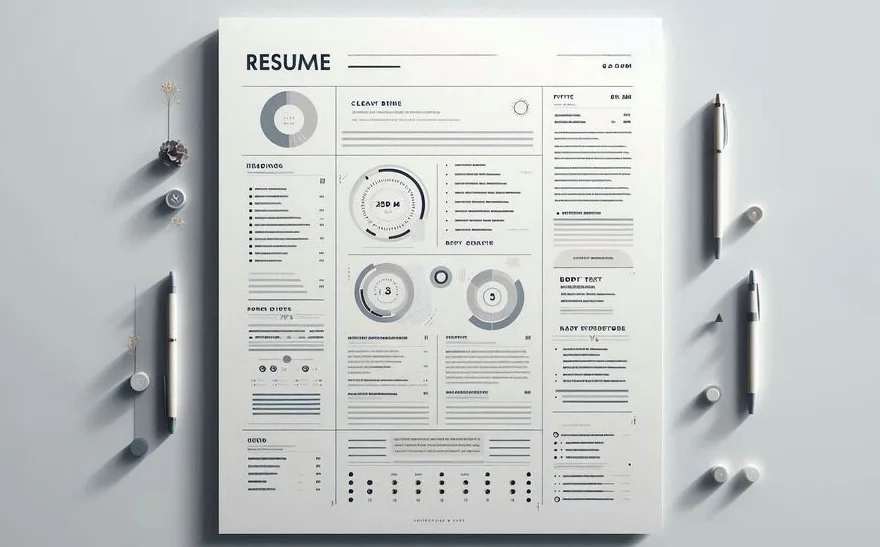
When it comes to crafting a professional resume, design plays a crucial role in determining how easily a recruiter can navigate and absorb your information. One of the most important yet often overlooked design elements is spacing. Proper spacing improves readability, enhances visual appeal, and ensures that your resume conveys the right message. In this blog post, we will dive deep into the best spacing ratios for modern resume readability, providing you with guidelines to make your resume visually appealing and easy to read.
The Importance of Spacing in Resume Design
Visual Clarity and Readability
Spacing is essential for making a resume clear and easy to read. When text is crammed too closely together, it becomes overwhelming, which can turn off recruiters who typically spend only seconds scanning each resume. By using appropriate spacing, you make it easier for the reader to quickly locate key information, such as job titles, skills, and accomplishments. Good spacing encourages recruiters to engage with your resume, allowing them to absorb your content without feeling visually fatigued.
Professional Appearance
Too much whitespace can make your resume look sparse and unfinished, while too little can create a cluttered, hard-to-read mess. Achieving the right balance of space is critical for giving your resume a polished, professional look. When done right, your resume's design will communicate that you understand the importance of clarity, structure, and attention to detail traits that are essential in any job role.
Key Spacing Elements to Consider
Margins
Margins are the white space around the edges of your resume. They set the boundaries for your content and help guide the reader’s eye. Too large of margins can make your resume look empty, while too small margins can make your content appear crammed and difficult to read. Generally, a margin of 1 inch on all sides is ideal for most resumes, although slightly smaller margins (0.75 inches) are acceptable if you're trying to fit more content onto a single page without sacrificing readability.
Line Spacing
Line spacing refers to the vertical distance between lines of text. For resumes, the standard line spacing is typically set between 1.15 and 1.5. Anything closer than 1.0 can make the text look cramped, while spacing greater than 1.5 can create unnecessary gaps. A line spacing of 1.15 to 1.25 allows for clear reading without taking up too much extra space. It strikes a balance between compactness and readability, which is crucial when presenting a resume in a professional manner.
Paragraph Spacing
Paragraph spacing refers to the space between individual sections or blocks of text, such as between job descriptions or different sections (e.g., education and work experience). In general, you should add extra space between these blocks to create a clear visual separation between different sections. A good rule of thumb is to add at least 6-8 points (or 0.1 inches) of space after each section. This ensures that your resume doesn’t appear cluttered and helps the reader quickly identify different areas of focus.
Ideal Spacing Ratios for a Modern Resume
Margin Ratios
For most modern resumes, a margin of 1 inch on all four sides of the page is the standard. This provides enough breathing room for the content without sacrificing space for text. However, in some cases, especially for resumes that have a lot of content or need to fit onto a single page, you can reduce the margins slightly to 0.75 inches to maximize available space. Keep in mind that reducing margins too much can make your resume look cluttered and reduce readability.
Line Spacing Ratio
The ideal line spacing for modern resumes typically falls between 1.15 and 1.5, with the sweet spot being around 1.2. This provides enough room between each line of text to ensure that the document looks professional without looking too spaced out. For resumes that are dense with information or require a lot of content in a small space, setting line spacing to 1.25 can help prevent your resume from feeling too cramped while still fitting everything neatly on the page.
Paragraph Spacing Ratio
In terms of paragraph spacing, leaving a gap of 6-8 points (or approximately 0.1 inches) between each paragraph or section is the most effective. This creates a clear visual distinction between each block of text and makes it easier for the recruiter to digest different sections of your resume. For resumes with dense content, you may want to slightly increase the paragraph spacing to help the resume feel less crowded.
Common Spacing Mistakes to Avoid
- Using inconsistent spacing between sections this can make your resume look unprofessional.
- Setting line spacing too tight (less than 1.0) or too loose (greater than 1.5) which impacts readability.
- Overcrowding the page with too much content, leading to small margins and minimal line spacing.
- Using excessive or irregular paragraph spacing that makes the resume look unbalanced.
Conclusion
Spacing is one of the most powerful tools in creating a modern, readable resume. The right spacing ratios can make your resume easier to read, more visually appealing, and better organized. Aim for a 1-inch margin, 1.15-1.5 line spacing, and 6-8 points of paragraph spacing to ensure your resume looks polished and professional. By optimizing your resume’s layout and spacing, you increase your chances of catching the recruiter's eye and making a positive first impression.