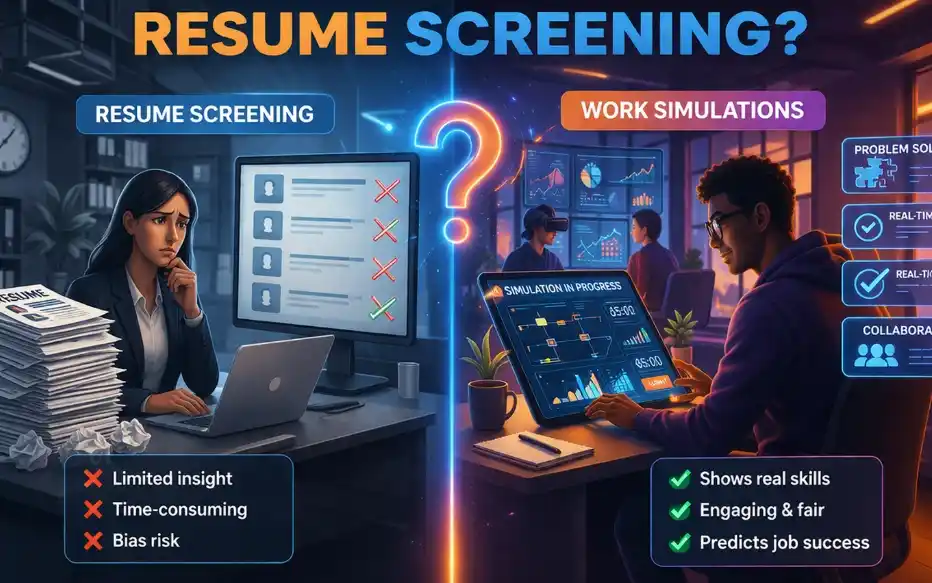
The hiring process is evolving as organizations seek more effective ways to evaluate candidates. Traditional resume screening has long been the first step in recruitment, allowing employers to filter applicants based on qualifications and experience. However, work simulations are emerging as a powerful alternative that focuses on assessing actual skills in real world scenarios. This shift raises an important question about whether work simulations could eventually replace resume screening or whether both methods will continue to coexist.
Understanding Work Simulations in Hiring
What Are Work Simulations
Work simulations are assessment methods that replicate real job tasks to evaluate a candidate’s ability to perform in a specific role. Instead of relying on self reported information, these simulations test practical skills and decision making abilities.
Types of Work Simulations
Common types of work simulations include case studies, technical assignments, role playing scenarios, and project based tasks. Each type is designed to measure specific competencies relevant to the job.
Role of Resume Screening in Hiring
Purpose of Resume Screening
Resume screening helps employers quickly identify candidates who meet basic requirements. It serves as an initial filter to manage large volumes of applications and narrow down the candidate pool.
Limitations of Resume Based Evaluation
Resumes rely on self reported information, which may not always accurately reflect actual skills. They also provide limited insight into how candidates perform in real situations. This can lead to mismatches between qualifications and job performance.
Work Simulations Versus Resume Screening
Evaluation of Real Skills
Work simulations provide direct evidence of a candidate’s abilities by testing real skills. In contrast, resumes offer indirect information based on past experience and descriptions.
Efficiency and Scalability
While resume screening is efficient for handling large numbers of applications, work simulations can be more time consuming. However, advancements in technology are improving the scalability of simulation based assessments.
Benefits of Work Simulations
Higher Accuracy in Assessment
Simulations allow employers to evaluate how candidates perform tasks, leading to more accurate assessments. This reduces the risk of hiring based on incomplete or misleading information.
Improved Fairness
By focusing on performance rather than background, work simulations can reduce bias and create a more level playing field for candidates with diverse experiences.
Better Candidate Experience
Candidates gain a clearer understanding of job expectations through simulations. This can help them assess whether the role aligns with their skills and interests.
Challenges of Replacing Resume Screening
Despite their advantages, work simulations face challenges such as higher implementation costs, time requirements, and the need for standardized evaluation criteria. Not all roles are suitable for simulation based assessment, especially those that require long term performance evaluation. Additionally, candidates may face difficulties if simulations are not designed effectively or fairly.
Future of Hiring Processes
The future of hiring is likely to involve a combination of resume screening and work simulations. Resumes will continue to provide a quick overview of qualifications, while simulations will offer deeper insights into skills and performance. Integrating both approaches can create a more comprehensive evaluation process.
How Candidates Should Prepare
Candidates should focus on developing practical skills and gaining real world experience. Preparing for simulation based assessments involves practicing problem solving, communication, and role specific tasks. Maintaining a strong resume is still important for initial screening stages.
Conclusion
Work simulations represent a significant advancement in hiring by focusing on real skills and performance. While they offer many benefits, they are unlikely to completely replace resume screening. Instead, both methods are expected to coexist and complement each other. By understanding this shift, candidates can better prepare for modern hiring processes and present their skills effectively.